- 작성일
- 2026.05.11
- 수정일
- 2026.05.11
- 작성자
- 임희창
- 조회수
- 43
A Transformer-Generative Adversarial Network Approach for Retrospective Prediction in Complex Dynamical Systems
Overview
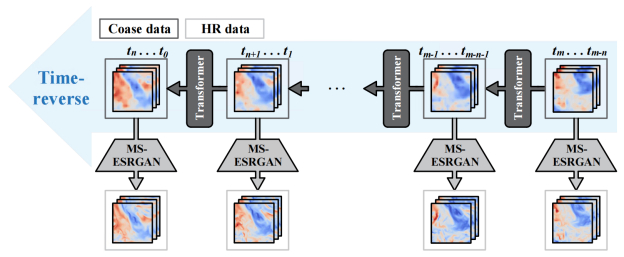
Accurate characterization of complex dynamical systems is crucial for understanding their intrinsic behavior, and retrospective prediction provides a promising solution. However, traditional methods often fail to effectively predict dissipative terms, which are key in dissipative dynamical systems. This study introduces a deep learning method (DLM) that combines a Transformer model with a multiscale enhanced super-resolution generative adversarial network (MS-ESRGAN) to improve retrospective predictions by extracting implicit information from temporal evolution data. The Transformer excels at capturing past dynamics, while MS-ESRGAN refines the predicted fields, achieving resolutions on par with ground truth data. The effectiveness of the DLM is demonstrated using two canonical flow cases: forced isotropic turbulence and a transitional boundary layer. The model closely matches the velocity fields of the ground truth, with only minor deviations attributed to the nonlinearity of the governing equations and the inherent difficulty in resolving small-scale structures. Additionally, the DLM is applied to National Oceanic and Atmospheric Administration (NOAA) sea surface temperature (SST) data, showcasing its practical utility for climate science. Despite challenges in capturing small-scale structures, the data-driven DLM outperforms traditional methods that either overlook the dissipative term or employ negative dissipative coefficients, representing a considerable advancement in retrospective predictions.
Dependencies
Python 3.6-3.8
tensorflow >=2.2.0<2.4.0 (cuDNN=7.6, CUDA=10.1 for tensorflow-gpu)
Numpy <1.19
Data Preparation
Taking the Sea Surface Temperature (SST) dataset as an example, the data preprocessing workflow includes reversing the time order, organizing and packaging the data into an input format suitable for Transformer, and randomly shuffling the packaged data.
The SST dataset is obtained from the NOAA OISST V2 High-Resolution Dataset, provided by the National Oceanic and Atmospheric Administration (NOAA) Physical Science Laboratory in Boulder, Colorado, USA (https://psl.noaa.gov). In this study, the high-resolution SST dataset has a spatial resolution of N_latitude×N_longitud=240×120, while the corresponding low-resolution SST dataset has a spatial resolution of N_latitude×N_longitud=30×15.
Training
Use the coarse-resolution SST time-series data together with `1Transformer_Training_SST.py` to train the Transformer model.
Use the paired coarse-resolution and hign-resolution SST datasets together with `3MS-ESRGAN_Training_SST.py` to train the MS-ESRGAN model.
Prediction
1. After training the Transformer and MS-ESRGAN models, use `2Transformer_Prediction_SST.py` to generate predictions for coarse sea surface temperature data.
2. Use the coarse sea surface temperature data predicted by the Transformer model and `3ESRGAN_Prediction_SST.py` to generate high-resolution sea surface temperature data.